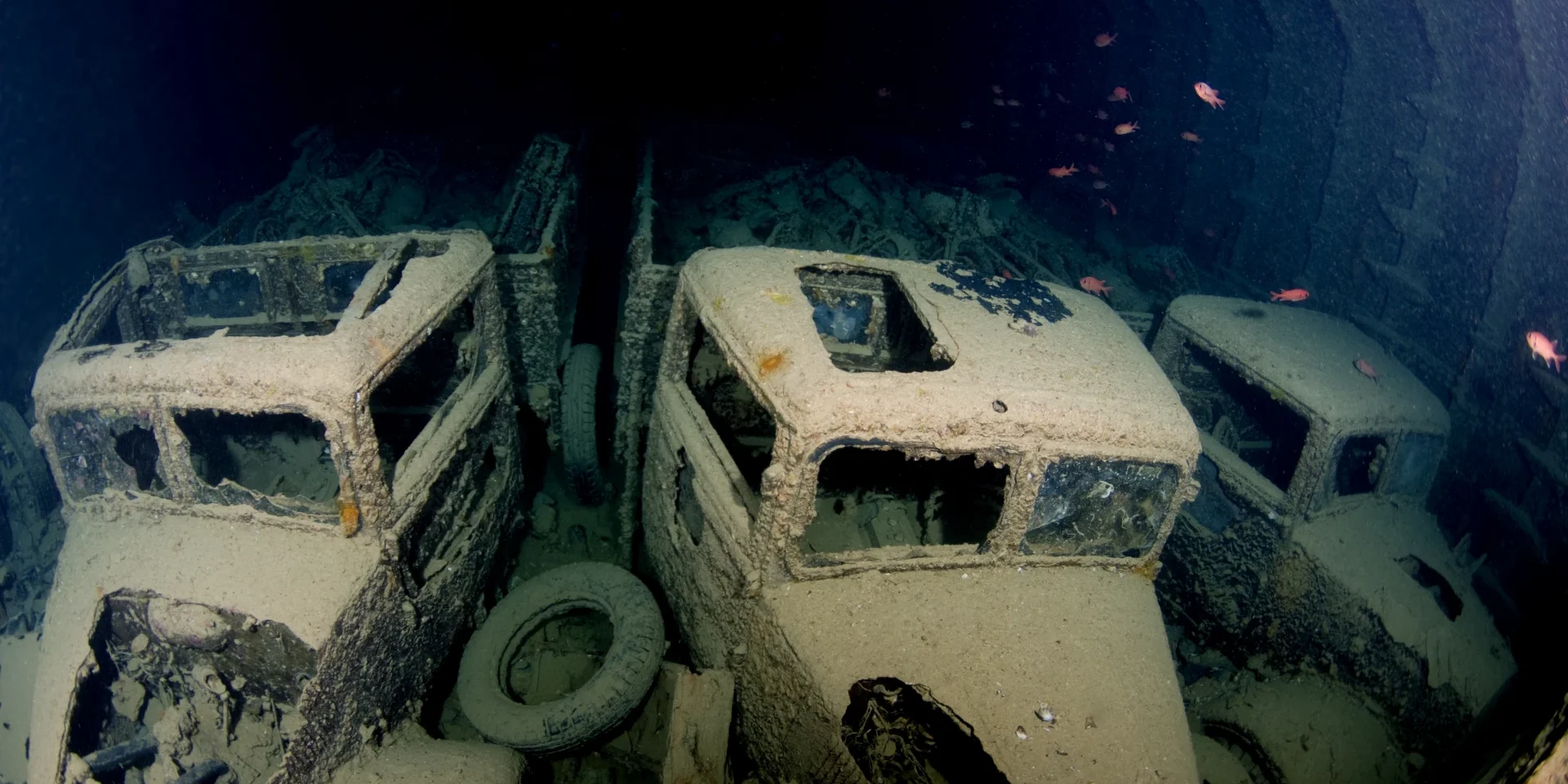
You drop down the line, the current tugging at your fins, and the shape below resolves out of the blue into something huge and unmistakably man-made. Then you see them: rows of motorbikes, still lined up in the hold where they were loaded in 1941. There’s nothing else quite like the SS Thistlegorm wreck dive, and for a lot of divers it’s the single reason they book a trip to Egypt’s Red Sea.
This isn’t just a big hull to swim around. The Thistlegorm is a wartime cargo ship frozen mid-voyage — trucks, motorcycles, rifles and even railway locomotives sitting on the seabed exactly where the sea took them. It’s history you swim through.
SS Thistlegorm — Quick Facts
| Location | Strait of Gubal, northern Red Sea — reachable from Sharm el-Sheikh, Hurghada and liveaboards |
| Depth | Deck around 16–18 m (52–59 ft); seabed at roughly 30 m (100 ft) |
| Water temp | Typically 21–22 °C (70 °F) in winter to 28–29 °C (84 °F) in summer |
| Visibility | Often 15–25 m (50–80 ft), but current-dependent |
| Difficulty | Advanced — depth, current and overhead penetration |
| Certification | Advanced Open Water recommended; wreck training for interior penetration |
The story behind the wreck
The Thistlegorm was a British armed merchant ship, launched in 1940 and pressed straight into wartime service. In October 1941 she was anchored in the Strait of Gubal, waiting for a safe passage up to the Suez Canal, loaded with supplies bound for Allied forces in North Africa.
She never made it. On 6 October 1941, two German Heinkel bombers found her in the dark and dropped their payload into the aft holds, where ammunition was stored. The explosion tore the ship apart and sent her to the bottom within minutes. Nine men were killed. It’s worth remembering that this is a war grave as well as a dive site — divers treat it with respect, and removing artifacts is off the table.
Cousteau put it on the map
Jacques Cousteau located the wreck in the mid-1950s and featured it in his work, raising a few items before the site slipped back into obscurity for decades. It wasn’t until the 1990s that Red Sea operators rediscovered it in earnest and turned it into the icon it is today. Now? On a calm morning you might share it with a dozen other boats.
What you’ll see on the SS Thistlegorm wreck dive
The cargo is the star here, and it’s astonishingly intact given eight decades underwater.
The holds and the machines
Drop into the forward holds and you’re swimming over the stuff of a wartime supply chain: BSA and Norton motorcycles, Bedford trucks, aircraft parts, Wellington boots, rifles, and stacks of ammunition. Some of the bikes are loaded into the beds of the trucks, exactly as they were shipped. Two steam locomotives — deck cargo, blown clear by the blast — now rest on the sand on either side of the hull, which is one of the more surreal things you’ll ever see at 30 m (100 ft).
The marine life that moved in
Eight decades in warm water turns a shipwreck into a reef. Dense clouds of glassfish fill the holds and part around your torch beam. Batfish hang in the current off the stern, lionfish patrol the railings, and crocodilefish and moray eels tuck into the structure. Early or late, trevally and tuna rip through the baitfish, and you’ll sometimes spot a turtle cruising the superstructure. For a wider sense of what shares this water, here’s the marine species you can expect across the Red Sea.
A locomotive on the seabed, motorbikes still racked in a truck bed, glassfish pouring out of a cargo hold — the Thistlegorm doesn’t feel like a dive so much as a walk through a paused moment in history.
Depth, current and difficulty — the honest version
This is not a beginner site, and it’s worth being straight about why. The deck sits around 16–18 m (52–59 ft), but the good stuff pulls you down to the seabed near 30 m (100 ft), which puts you firmly in Advanced Open Water territory. Bottom time goes quickly at that depth, so many divers run this on nitrox to stretch it out and pad their safety margin.
Then there’s the current. The Strait of Gubal can be gentle one day and rip the next, and the descent along the mooring line is where people get caught out. A drift onto the wreck is manageable with a guide who knows the site; getting blown off it in blue water is not the plan.
Tip: Book the earliest boat you can. The first divers of the day get calmer conditions, better light in the holds, and the wreck to themselves before the crowd arrives. A torch is essential even on the exterior — the holds swallow light fast.
A word on penetration
Swimming through the large, open holds is within reach for many Advanced divers with a good guide. Pushing deeper into the engine room and the tighter, silt-heavy spaces is genuine overhead-environment diving — that needs proper wreck training, a reel, and a plan. Don’t let the crowds fool you into thinking it’s casual. Stay inside your certification, keep your buddy close, and if a passage looks tight and dark, it’s fine to hang back and enjoy the wreck from outside.
How to dive the Thistlegorm
You’ve got three realistic ways in. Day boats run from Sharm el-Sheikh, though it’s a long crossing and an early start. Trips also come out of the Hurghada side, and if you’re already planning a Red Sea trip, our guide to diving out of Hurghada is a good place to start.
The most relaxed option, though, is a liveaboard. The classic northern wreck-and-reef itineraries include the Thistlegorm alongside sites like Ras Mohammed, and staying out on the water means you can hit the wreck early and often, before the day boats show up. Have a look at how liveaboard trips work if you haven’t done one before.
Caught the wreck bug? Egypt is just the start. If you want to go deeper into shipwreck diving, the eerie WWII fleet of Truk Lagoon in Micronesia is the other pilgrimage every wreck diver ends up making.
SS Thistlegorm FAQ
What certification do I need for the Thistlegorm?
Advanced Open Water is the sensible minimum because of the depth and current. You can experience plenty of the wreck without going inside, but any real interior penetration calls for wreck training. Nitrox certification is a big plus for bottom time.
How deep is the SS Thistlegorm wreck dive?
The deck sits around 16–18 m (52–59 ft) and the seabed is near 30 m (100 ft). Most dives work the shallower superstructure and the tops of the holds, dropping deeper only where depth and your gas plan allow.
When’s the best time of year to dive it?
The Red Sea is diveable year-round. Summer brings the warmest water and calmest surface, while winter is cooler and can be windier in the exposed Strait of Gubal. Spring and autumn are a comfortable middle ground.
Is it suitable for a first wreck dive?
It can be, with the right prep — an Advanced cert, solid buoyancy, and a good guide who briefs the site properly. If you’re brand new to depth or current, get a few Advanced dives under your belt first so you can actually enjoy it rather than task-load through it.
Ready to see it for yourself?
The Thistlegorm earns every bit of its reputation. Few dives anywhere blend history, machinery and marine life the way this one does — and it rewards divers who show up prepared. Sharpen your buoyancy, brush up your Advanced skills, and start mapping out a Red Sea dive trip that puts this wreck at the top of the list. It’ll be worth the early alarm.