Trigger-Happy: Meeting the Feisty Residents of the Red Sea
If you’ve spent any time on the vibrant reefs of Hurghada, Sharm El Sheikh, or Marsa Alam, you’ve likely locked eyes with a triggerfish. These are not your average “background” reef fish. Triggerfish are the heavyweights of the personality world—intelligent, curious, and, during certain times of the year, famously territorial.
Belonging to the family Balistidae, triggerfish get their name from a unique biological mechanism. Their first dorsal fin is composed of three spines; the first is large and can be locked into an upright position by the second “trigger” spine. This allows them to wedge themselves into reef crevices at night, making it impossible for a predator to pull them out.
But for many, the triggerfish is best known as the fish that dares to challenge a scuba diver.
 The Titan of the Reef: Balistoides viridescens
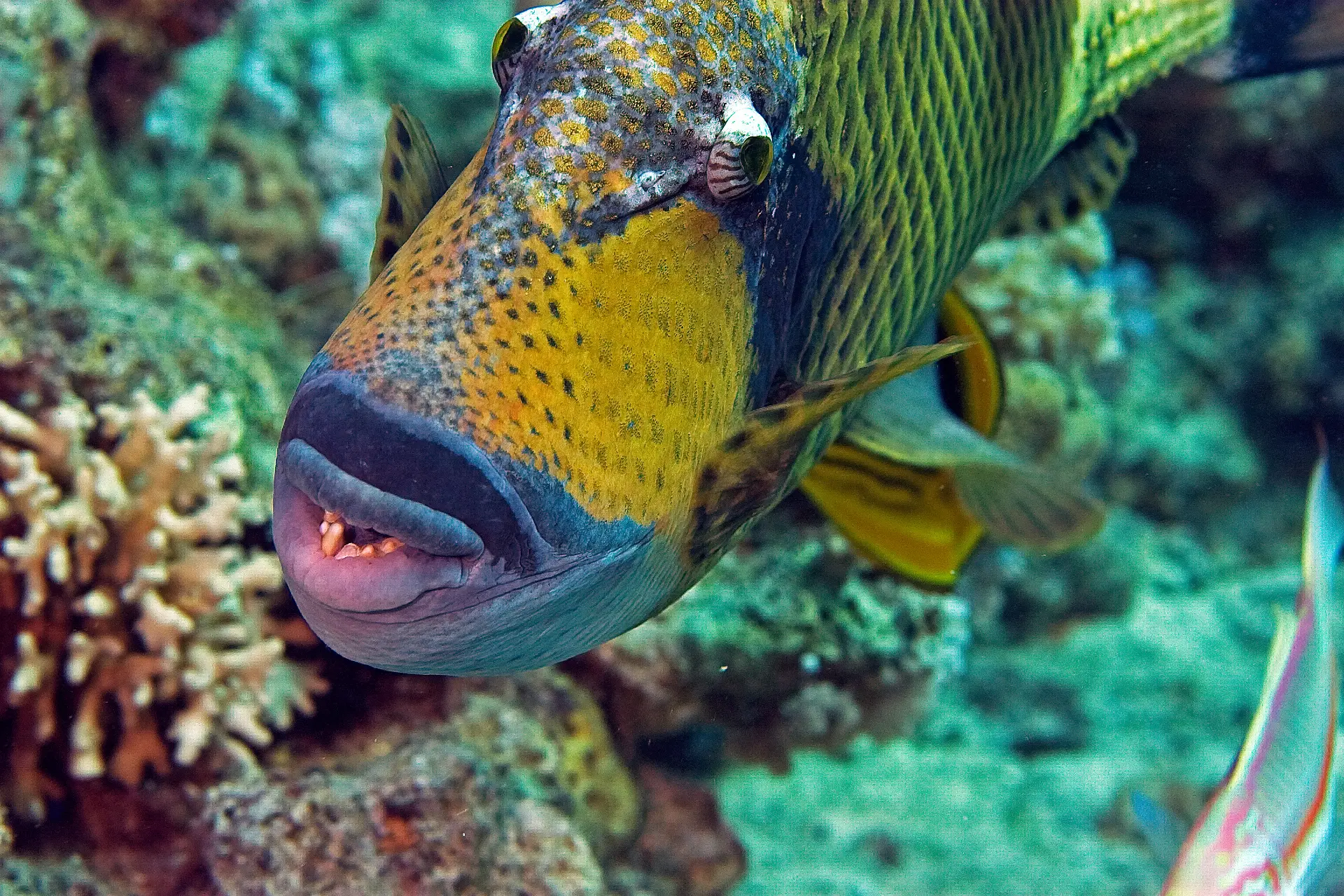
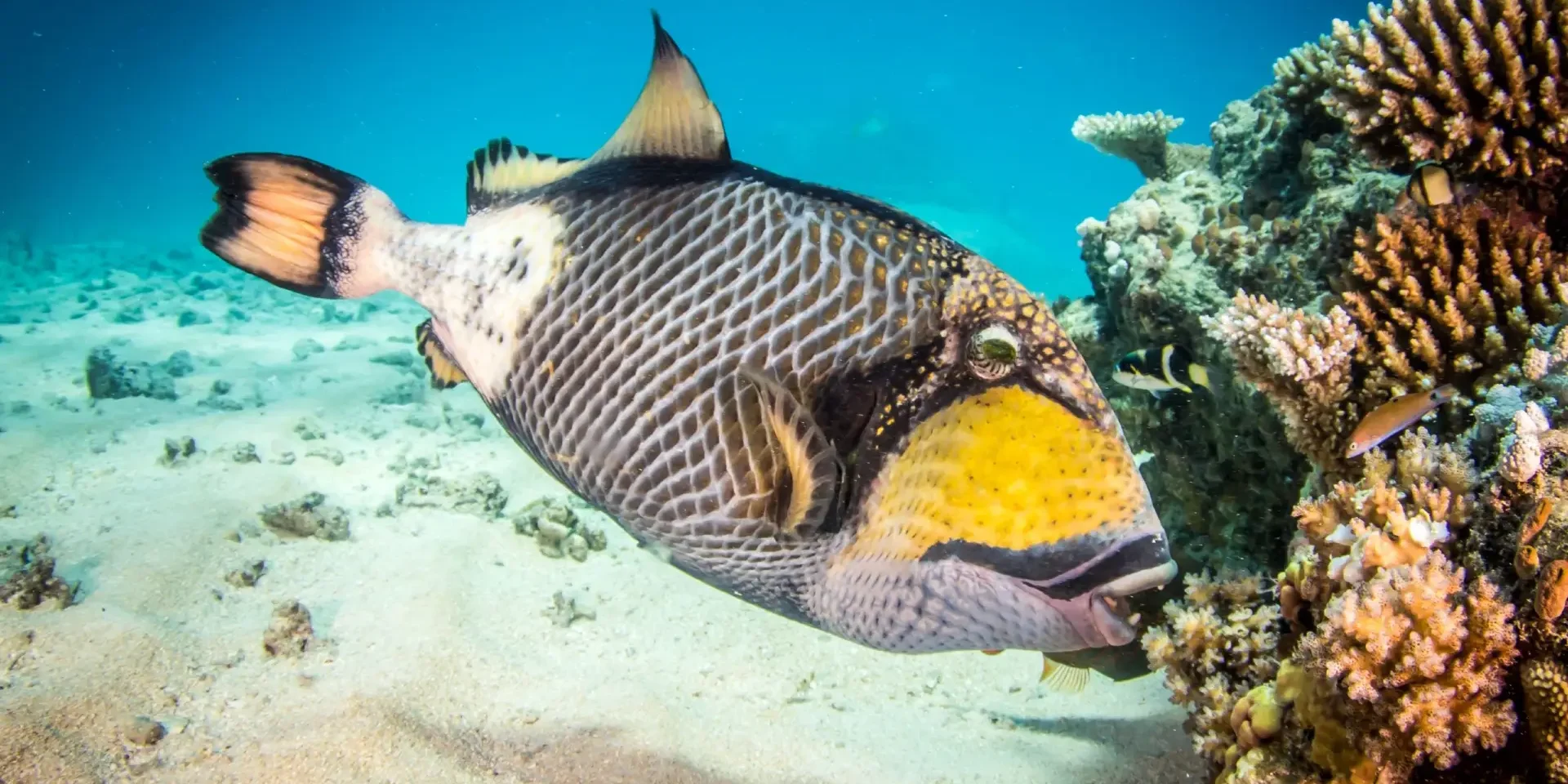
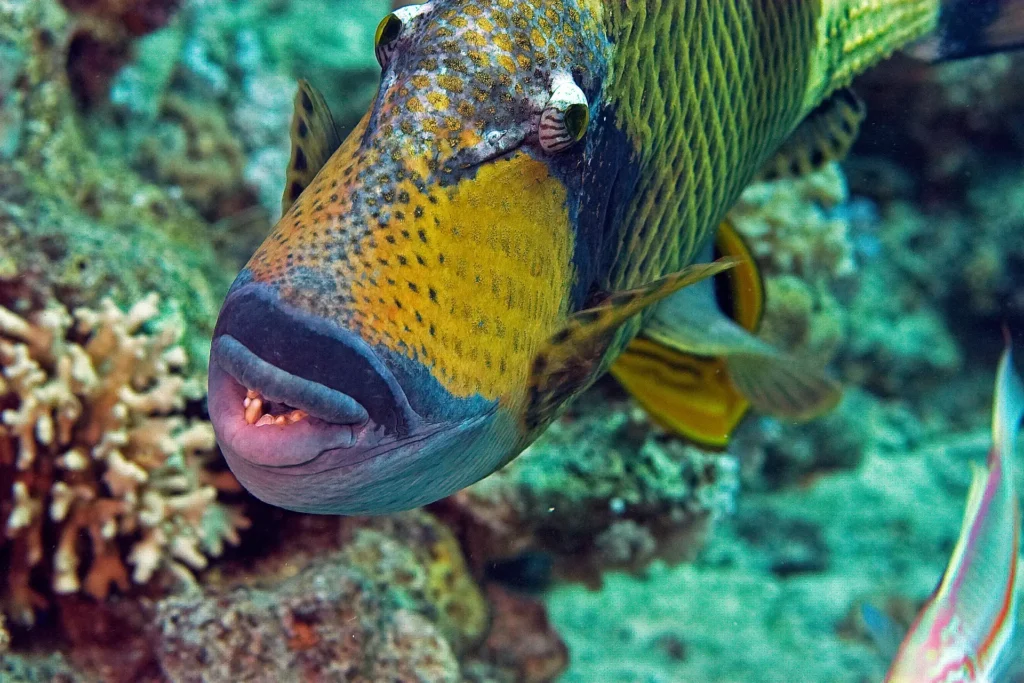
The undisputed heavyweight champion of the Red Sea is the Titan Triggerfish. Reaching lengths of up to 75 centimeters (30 inches), these are the largest triggerfish in the region. With their heavy, scale-covered bodies, yellow faces, and distinctive “mask” across the eyes, they look like armored tanks of the coral world.
Titans are industrious. You will often see them flipping over large rocks or crushing branching coral with their powerful, human-like teeth to get at sea urchins, crustaceans, and mollusks. It is this incredible bite force that makes them a creature to respect; their jaws are designed to crush through calcium carbonate like it’s a biscuit.
The “Danger Cone”: Navigating Nesting Season
The Titan’s reputation for aggression isn’t random—it’s parental. During the summer nesting season (typically June through August), females guard their eggs in shallow, sandy depressions on the seafloor.
If you are diving in Egypt during these months, you need to be aware of the “Danger Cone.” Unlike most fish that defend a small radius, the triggerfish defends a cone-shaped territory that starts at the nest and expands upward toward the surface.
How to handle a Titan encounter:
-
Watch for the Warning: If a Titan feels threatened, it will erect its trigger spine. If it rolls onto its side to look at you with one eye, you are in the danger zone.
-
Go Horizontal: Because their territory is a cone shape, swimming up actually keeps you inside their zone longer. The only way to escape a charging Titan is to swim horizontally away from the nest as quickly as possible.
-
Fins Out: If a Titan does charge (and they are surprisingly fast), keep your fins between you and the fish. They are attracted to movement and color (especially yellow fins), and it’s much better for them to take a nibble out of your rubber fin than your leg.
 The Arabian Picasso: The Reef’s Resident Artist
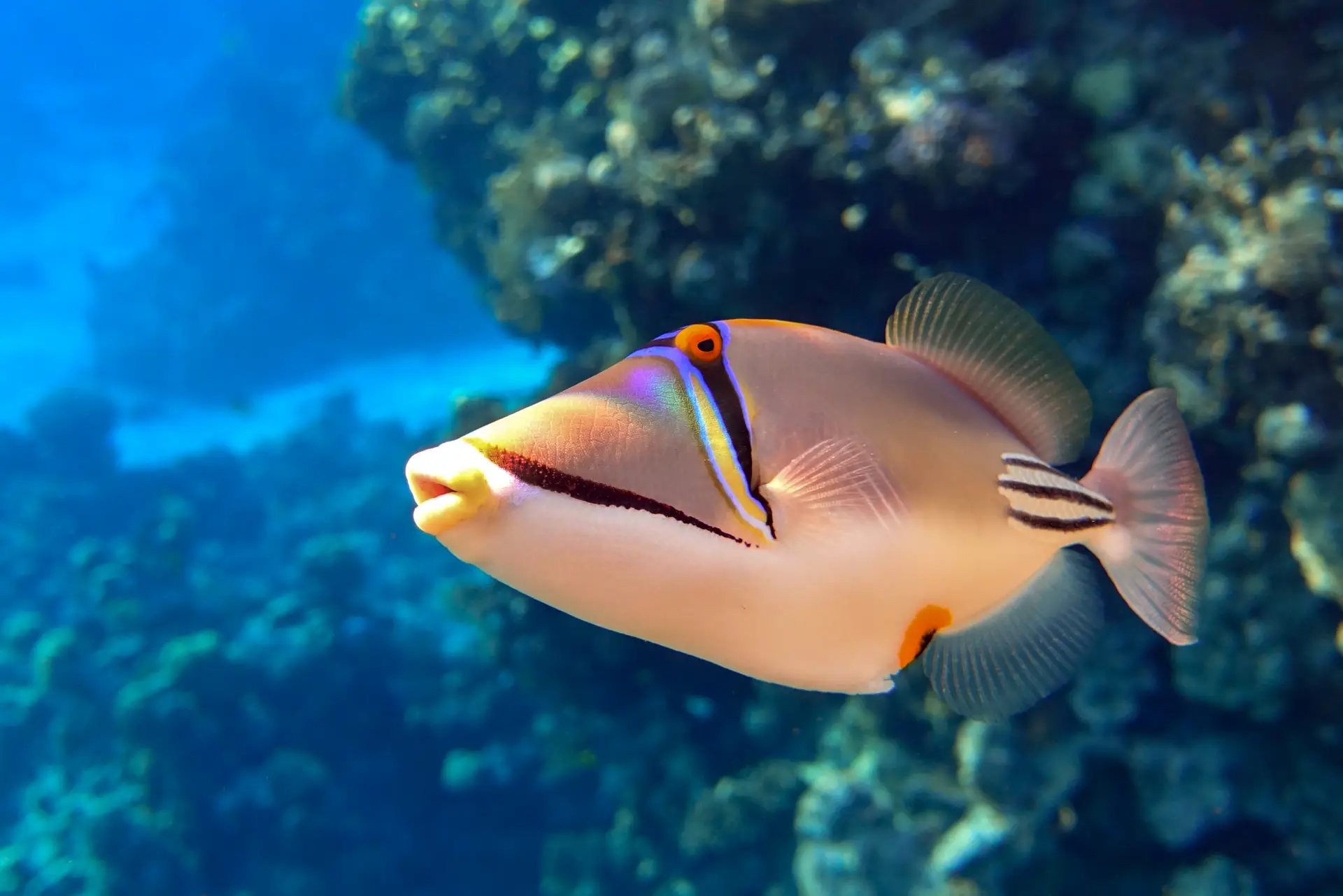
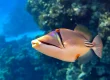
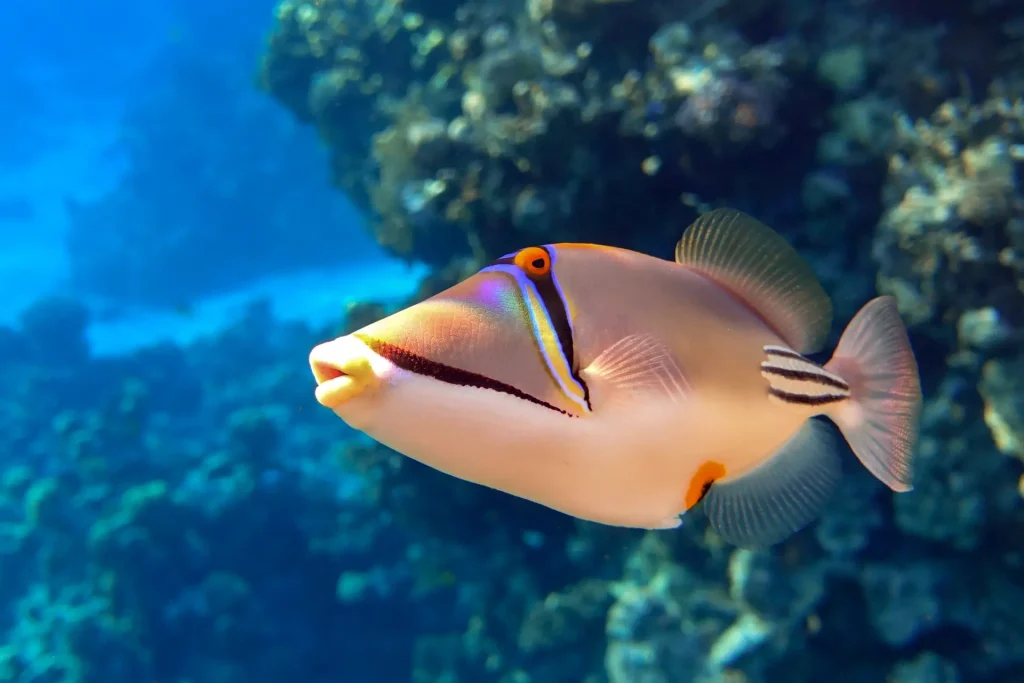
On the other end of the spectrum is the Arabian Picasso Triggerfish (Rhinecanthus assasi). Endemic to the Red Sea and Gulf of Oman, these fish look like they were painted by a cubist master. With electric blue lines across their heads and a bizarre mix of tan, white, and yellow geometric patterns, they are a favorite for underwater photographers.
While much smaller than the Titan, the Picasso is just as busy. They are constantly “rearranging” the reef, picking up pieces of rubble and moving them to suit their needs. While they are territorial, they are far less likely to charge a diver, usually preferring to duck into a hole and lock their trigger spine if they feel overwhelmed.
The Socialites: Red-Toothed Triggerfish
If you’ve ever looked up from a deep wall at a site like Elphinstone or Shark Reef and seen a massive “cloud” of dark blue fish with lyre-shaped tails, you were looking at Red-Toothed Triggerfish (Odonus niger).
Unlike their solitary cousins, Red-Toothed Triggerfish are highly social and feed on plankton in the water column. While their name sounds intimidating, their “red teeth” are actually quite small and only visible if you get very close. They are a beautiful addition to any dive, creating a shimmering blue curtain against the deep indigo of the Red Sea’s open water.
Why We Love Them
Despite their “cranky” reputation, triggerfish are a sign of a healthy, balanced reef. They are one of the few predators capable of keeping sea urchin populations in check, which prevents the overgrazing of the coral.
As a diver, a run-in with a Titan Triggerfish is a rite of passage. It reminds us that we are guests in a wild world where even a “small” fish can be the boss of its own domain. Whether you’re admiring the geometric beauty of a Picasso or giving a wide berth to a nesting Titan, these fish add a layer of character and excitement to every dive in the Red Sea.